


 Zwiń opis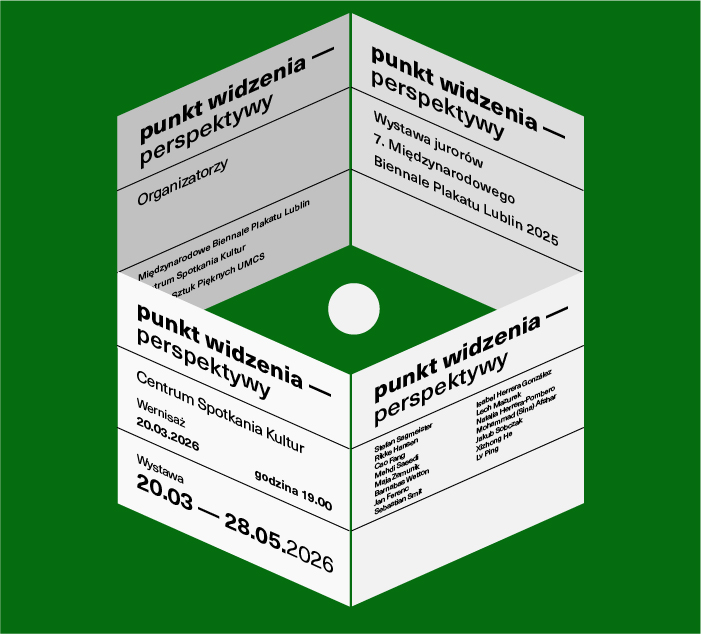
W jednym miejscu spotykają się różne wrażliwości, języki wizualne i strategie projektowe — od klasycznie rozumianego plakatu artystycznego, przez grafikę i malarstwo, aż po formy instalacyjne. Wystawa odsłania to, co zwykle pozostaje „za kurtyną” oceny: osobiste kryteria, doświadczenie i wyobraźnię osób, które współtworzyły werdykt biennale.
Ekspozycja buduje wielogłosowy portret współczesnej sceny grafiki i sztuk wizualnych. Każdy z zaproszonych twórców prezentuje prace charakterystyczne dla swojej praktyki — rozpoznawalne w temacie, geście, typografii, rytmie obrazu czy sposobie budowania znaczeń. W rezultacie powstaje mapa perspektyw: równoległych, czasem sprzecznych, ale zawsze skoncentrowanych na sile komunikatu.
Uczestnicy
W wystawie biorą udział uznani artyści i projektanci z różnych części świata: Stefan Sagmeister, artysta, projektant graficzny i typograf; Rikke Hansen, projektantka i edukatorka zajmująca się rozwojem designu oraz badaniami w tej dziedzinie; Cao Fang, profesor w Nanjing Arts Institute, członek Alliance Graphique Internationale (AGI); Mehdi Saeedi, irańsko-amerykański projektant i artysta wizualny, członek Alliance Graphique Internationale (AGI); Maja Zemunik, artystka i nauczycielka akademicka z bogatym doświadczeniem w grafice, uczestniczka prestiżowych wystaw; Barnabas Wetton, wystawiał m.in. w Royal Academy, Trapholt i Charlottenborg, a dwa jego projekty dydaktyczne znajdują się w zbiorach MoMA; Jan Ferenc, grafik i profesor sztuk plastycznych, organizator i kurator znaczących wydarzeń artystycznych; Sebastian Smit, artysta wizualny, projektant, nauczyciel akademicki; Isabel Herrera González, artystka, doktorantka, stypendystka FPU; Lech Mazurek, plakacista, grafik, nauczyciel akademicki na Wydziale Artystycznym Maria Curie-Skłodowska University (UMCS); Natalia Herrera-Pombero, artystka i architektka, w rysunku poszukująca piękna „skamieniałej muzyki”; Mohammad (Sina) Afshar, artysta i wykładowca akademicki specjalizujący się w projektowaniu plakatu; Jakub Sobczak, projektant plakatów i ilustrator książkowy, inspirujący się sztuką ludową i historycznymi technikami graficznymi; Xizhong He, wykładowca w Szkole Projektowania i Sztuki przy Pekińskim Instytucie Komunikacji Graficznej, zajmujący się sztuką wizualną; Lv Ping, doktor nauk, prodziekan Szkoły Sztuki i Designu na Uniwersytecie Nauk Elektronicznych w Guilin, profesor wizytujący w Rhode Island School of Design (RISD) oraz Central Academy of Fine Arts.
Co zobaczymy na wystawie
Prezentowane prace obejmują m.in. plakat artystyczny, grafikę artystyczną, malarstwo oraz instalacje artystyczne. To przekrój postaw i metod — od precyzyjnie projektowanej typografii i skrótu wizualnego, po działania bardziej autonomiczne, materialne i przestrzenne. „Perspektywy” nie są tu hasłem: to realne, różne sposoby patrzenia na obraz, komunikat i rolę sztuki w przestrzeni publicznej.
Wystawa Punkt widzenia — Perspektywy jest zaproszeniem do przyjrzenia się temu, jak myślą i pracują twórcy, którzy współtworzą międzynarodowe standardy oceny plakatu — oraz do spotkania z ich własnymi, autorskimi opowieściami zapisanymi w obrazie.
Punkt widzenia – Wystawa jurorów 7. Międzynarodowego Biennale Plakatu Lublin 2025
20.03.2026 r. | godz. 19.00 – Wernisaż
Wystawa do 28.05.2026 r. | godz. 8.00-21.00
Ciche Kąty +1
Wstęp bezpłatny
Wersja angielska
Viewpoint — Perspectives is a unique presentation of the work of the jurors of the 7th International Poster Biennale Lublin 2025. It brings together, in one place, different sensibilities, visual languages and design strategies — from the classic understanding of the artistic poster, through graphic art and painting, to installation-based forms. The exhibition reveals what usually remains “behind the curtain” of evaluation: the personal criteria, experience and imagination of those who helped shape the Biennale’s verdict.
The show offers a polyphonic portrait of today’s graphic and visual arts scene. Each invited creator presents works that are distinctive to their practice — recognisable in subject, gesture, typography, image rhythm and the way meanings are constructed. The result is a map of perspectives: parallel, sometimes contradictory, yet always focused on the power of the message.
Participants
The exhibition features acclaimed artists and designers from around the world: Stefan Sagmeister, an artist, graphic designer and typographer; Rikke Hansen, a designer and educator specialising in design development and research; Cao Fang, Professor at Nanjing Arts Institute and a member of the Alliance Graphique Internationale (AGI); Mehdi Saeedi, an Iranian-American designer and visual artist, and a member of the Alliance Graphique Internationale (AGI); Maja Zemunik, an artist and academic teacher with extensive experience in graphic art, who has participated in prestigious exhibitions; Barnabas Wetton, who has exhibited at the Royal Academy, Trapholt and Charlottenborg, with two of his educational projects held in MoMA’s collection; Jan Ferenc, a graphic artist and Professor of Fine Arts, organiser and curator of major artistic events; Sebastian Smit, a visual artist, designer and academic teacher; Isabel Herrera González, an artist, PhD candidate and FPU scholarship holder; Lech Mazurek, a poster artist and graphic designer, academic teacher at the Faculty of Arts, Maria Curie-Skłodowska University (UMCS); Natalia Herrera-Pombero, an artist and architect who, through drawing, seeks the beauty of “petrified music” — a lasting trace of the fleeting moment of sound; Mohammad (Sina) Afshar, an artist and academic lecturer specialising in poster design; Jakub Sobczak, a poster designer and book illustrator inspired by folk art and historical printmaking techniques; Xizhong He, a lecturer at the School of Design and Art at the Beijing Institute of Graphic Communication, working in visual art; and Lv Ping, PhD, Vice-Dean of the School of Art and Design at the Guilin University of Electronic Technology, a visiting professor at the Rhode Island School of Design (RISD) and the Central Academy of Fine Arts.
What you will see
The works on display include, among others, artistic posters, graphic art, painting and art installations. It is a cross-section of attitudes and methods — from precisely designed typography and visual shorthand to more autonomous, material and spatial approaches. “Perspectives” is not a slogan here: it points to real, varied ways of looking at the image, the message, and the role of art in public space.
Viewpoint — Perspectives invites visitors to look closely at how the artists who help shape international standards for judging posters think and work — and to encounter their own, authorial stories inscribed in the image.